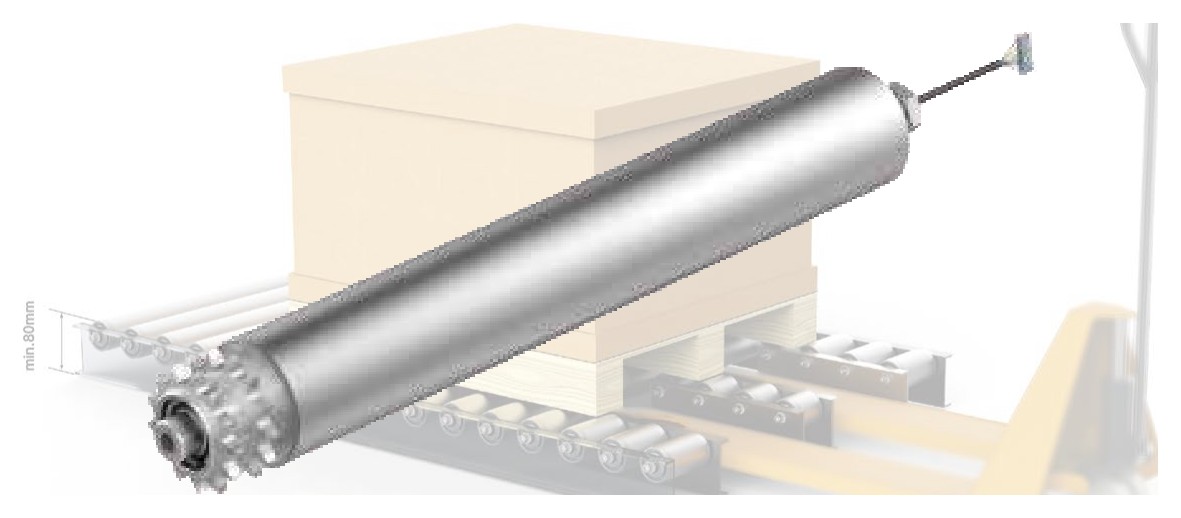
Motorized Rollers
Carton and tote conveying lines, including diverter, merge, scan stations and telescopic loaders.
A motorized roller has the motor and the driver inside the tube. There is no external gearbox, no line shaft and no chain guard: 24 V enters through a cable at the shaft end, and the roller drives its neighbours with O-belts or poly-V belts. On carton and tote lines this is the most common architecture, because it removes the oil, the guards and the single point of failure that a central drive brings, and lets each zone start and stop on its own.
The Φ50 and Φ60 sizes cover cartons, totes and trays. Two power levels are offered: ECO at 40 W for transport sections and gentle accumulation, BOOST at 50 W for inclines, merges, transfers and heavier totes. Rated current is 2.5 A and 3.5 A, starting current 3.0 A and 5.0 A, all at 24 V DC — so the power supply is sized for the number of rollers that start together, not for the total installed. Drive connections include straight (no drive), sprocket, grooved, poly-V, O-belt and timing pulley, which lets one roller type cover a transport section, a driven group and a curve.
Protection is IP54 as standard and IP68 as an option for washdown and exposed docks. The installation rules are simple and unforgiving: keep the roller square to the frame, keep belt tension at the level that transmits the load without slipping, and never start more rollers at once than the supply is rated for. On lines with many zones the inrush at power-up is what trips supplies, so zones are started in sequence or the supply is sized against the starting current of the largest group that starts together.
No. Each roller has its own integrated Driver and needs 24 V DC plus a run signal. Zones are switched by photo-eyes or by the PLC, and rollers can be grouped so that one signal starts a whole zone.
Against starting current, not rated current. Add the starting current of the rollers that start at the same moment, add the running current of the rest, and keep 20–30 % headroom. A supply sized on rated current alone will trip on a cold start.
ECO at 40 W for level transport and light accumulation; BOOST at 50 W for inclines, merges, transfers, heavy totes, and any point where the roller starts under load.
Up to 400 kg per roller on carton lines, provided the load is carried as designed — several rollers under the item, and a frame that keeps them aligned. Roller capacity and conveyor capacity are not the same thing.
Only with the IP68 option. Standard IP54 resists dust and splashes but not directed water or immersion. For food lines specify IP68, and stainless wherever the roller is exposed.
The integrated Driver sets roller speed and ramps start and stop. Several rollers can be synchronised so a zone runs at one speed. Line speed is chosen for the product and the transfer, and confirmed at commissioning.
Diameter, wall thickness, shaft end, drive and load — send them and you get a drawing and a price, not a catalogue page.